My wife called me a vampire before I ever saw the clip.
Marc Andreessen — the “software eats the world” guy — was on Joe Rogan’s podcast describing what AI coding is doing to developers’ hours: people working more, not less. I think it’s because the opportunity in front of us feels like a now-or-never window. There’s already a name for it circulating in the industry: the “AI vampire” — up all night because you’re too productive to shut it off.
When I saw it, I played it for my wife right away. It explained what I’d been going through the last month and a half better than I’d been able to myself.
The Machine Grows as it Goes
AI has unlocked new abilities — the resources and know-how to put things I’d wanted to do for years into actual motion. Recognizing what’s suddenly possible has shifted where I put my effort, pouring time into these newly open doors, chasing the return on the opportunity. And more.
The act of building with AI seems to continually spawn new ideas and opportunities. They spring up with the build, as it unfolds. It’s like exploration — you don’t know what you’re going to encounter until you encounter it. There’s a real sense of excitement, adventure, discovery, and accomplishment. But you have to keep moving, it seems. Without that act of building — without movement — the old ideas remain dormant and the new ones quickly expire. Build speed has increased so dramatically with the advent of AI that the shelf life on an unexplored idea is no longer years. It’s days — just ask the prompt engineers. A few days after people had built real expertise around prompt engineering, the agentic harness came along and folded that whole skill into itself.
And it adds fuel to the fire when people like Elon Musk come out and say things like this.
“In 5 years, by 2031, digital intelligence will exceed the sum of all human intelligence.” — Elon Musk
The sense of urgency is right in our faces, as long as we pay attention. Who has time to sleep?
There’s a real sense that if you’re not building it now, a thousand other people already are. And nobody wants to miss the opportunity to be first out with the next great thing. Sitting still means falling behind.
But after a month and a half I’m realizing that this is a trap. Not the process of building itself — the building is what actually moved three things I’d been stuck on for years from dead to alive (more on those in a minute). The trap is the urgency underneath it: the fear of being scooped by the competition, the sense that a thousand other people are already building your idea, the pull toward chasing scale instead of just doing the work in front of you.
In fact, I posted about it on X last night.
What I mean by that is it’s foolish to go chasing after magic beans. The things in life that have real value almost always involve hard work, dedication, and — yes — a little bit of luck.
I asked my AI system to interview me about this topic and here’s the result of our interview.
Q — Name two or three projects that sat as ideas for years before AI. What was actually blocking them?
SolveTheUniverse.com is the oldest one — an interest going back to childhood, trying to understand how the universe actually works. I’d attempted the site more than once. One attempt got hacked. Another got taken offline after someone filed a bogus spam complaint against a site that was clearly not spam. This time, for the first time, I’ve had enough horsepower to actually assemble the pieces and put real, hard, unsolved problems in front of people in a way that invites conversation instead of a dead page.
AdBlob — my eBay affiliate storefront — just needed enough resources to get a couple of pages built and live. Small, but it had been sitting on a shelf.
Texas Rain is the one that means the most. My friend Lynn Hobbs gave me his memoir manuscript before he passed away. I’d taken it to a publisher once — they did a proofread pass but weren’t interested in actually publishing it. With AI doing the editing and formatting work and Amazon KDP as the publishing platform, it’s out now: the Kindle edition is live, and we’re cleaning up formatting errors on the paperback.
Three things that were completely dead a month and a half ago, with no real path forward, that I’ve made major movement on since.
What “more hours, not fewer” actually looked like
Q — Has “AI coding means more hours, not fewer” been true for you? What does a heavy night actually look like?
It was true. I was getting up at midnight, 2 a.m., working, learning — not because I had to, but because the sense of opportunity pulled at me. Now or never. Early on, before the system was stable, a lot of that time went into building the guardrails themselves — breaking things, fixing things, teaching the system how to actually produce reliable work instead of just output (everybody hates AI slop).
That’s easing off now, a month and a half in. Not because the pull is gone, but because the steepest part of the learning curve is behind me.
Q — Does the “AI vampire” term itself land for you? Is there one specific night that sticks out?
Yes — mostly because my wife already said it, unprompted, before this clip existed.
But I don’t think the $50 million framing is the honest version of this. It’s the same shape as every kid who thinks “pro ball player” is a career plan. A few people are going to be the AI star, the hero of the story everyone’s watching. Most won’t. I’m not in a position to say where any of us will actually be in five years — it would be great if we all found real success, but only time will tell. That doesn’t make it worthless — it means it plays out like every other technology before it: computers, then the internet, now this. Some people will do very well with it. A lot more will build solid, useful careers around it. That’s not a consolation prize; that’s just how it goes.
There’s nothing new under the sun. It’s a new tool doing the same old things — thinking, communicating, processing. Pen and paper in the transistor age.
The money question
Q — Does the $50 million / “philosopher’s stone” line resonate, or is what’s pulling you into this something else?
Early on, there was a real pull — this thing could make us rich. That may even be true for some people. But rushing toward it is the wrong instinct, and Scripture is direct about why:
“A faithful man shall abound with blessings: but he that maketh haste to be rich shall not be innocent.” — Proverbs 28:20 (KJV)
“Wealth gotten by vanity shall be diminished: but he that gathereth by labour shall increase.” — Proverbs 13:11 (KJV)
Turning AI into a get-rich-quick scheme is the wrong way to hold this tool — I felt that pull myself, early on.
What actually produces value for people is hard work, dedication, and learning — the unglamorous stuff. Wealth that’s handed to you tends to evaporate; work done with diligence — done as unto the Lord, echoing Colossians 3:23 — is what actually lasts. Labor isn’t going away. It’s just picking up a new tool.
The cost — and the trigger that caught it
Q — Has staying up late on this ever actually tipped into fatigue or complacency, or has it stayed net-positive so far?
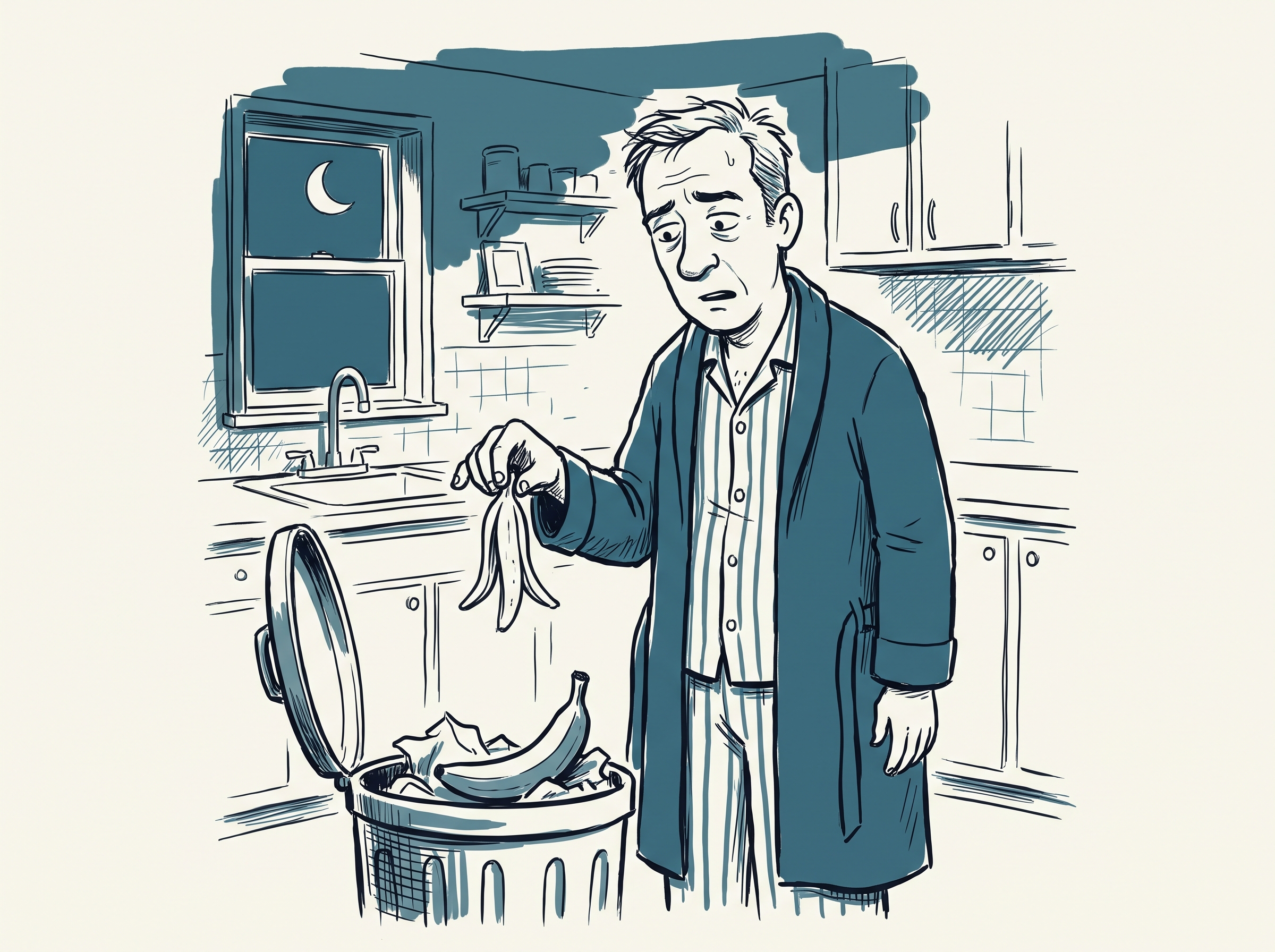
One night, distracted, I peeled a banana — then threw the banana itself in the trash and was left standing there holding the peel.
That’s the mistake this whole thing can become: keep the peel, throw away the banana. The peel is AI chased for ill-gotten gain — get-rich-quick, waste. The banana is honest work — the actual fuel for a good life. Staring at that trash can, I stopped cold.
My prayer, then and now — for me, for my family, and for you reading this too: God, don’t let us throw away the good stuff holding onto the peel.
Like my old friend Randall Gray used to say: “Slow down and live.”
Where this leaves us
Q — What would you tell someone sitting on their own backlog of “wanted to build it for years, never had the bandwidth”?
I’m not in a position to tell anyone else what to do with this. A month and a half in, I’m not an expert — I’m just someone who finally built the things I’d wanted to build.
What it gave me was real. SolveTheUniverse, AdBlob, and Texas Rain all moved from dead to alive in a month and a half, because for the first time I had something that remembers — a system I keep coming back to, not a one-off I’d have to relearn from scratch every time.
And the risk is real and ongoing. Data security isn’t something I solved once and moved past; it’s something I keep working at.
Here’s the part I owe you straight, though: the shelf-life panic — the sense that ideas expire in days, that a thousand other people are already building yours — was mostly comparison, not something I actually measured. I still think speed matters; shipping the thing in front of you today beats a perfect version next month. What I stopped doing was chasing being first, chasing scale, chasing the imaginary payout. That’s the actual line, and here’s the test: if the effort delivers — real payoff, real return — it was warranted urgency, not a trap. The trap is when you’re left holding the peel with the banana already in the trash: all that effort, and nothing kept.
So this isn’t a pitch. It’s just what the last month and a half has actually been — close enough to what Andreessen described that my wife recognized it before I could name it myself.
On perfection
If you want AI to be perfect, you’ll struggle. What I typically put out with this system feels about 80 or 90% right — good enough to post, but not exactly the quality I want right out of the gate. The good stuff, the 100% articles and materials, currently takes many iterations, a lot of refining, to actually get there.
This article is a good example. The wording, the points I’m trying to get across — it’s about 90%. But I’m posting it as is. Why? A line often attributed to George Patton puts it better than I can: “A good plan, violently executed now, is better than a perfect plan next week.”
This article was produced on my cell phone with my second brain system, in a few minutes of “spare” time. I hope you enjoyed it and I hope it helps.
God bless you on your journey.
If this helps you, check out my adblob to support the work.



Verify you're not a bot to load comments: