The Retry Loop Was the Real Problem, Not the Platform
Covers July 15, 2026 · published August 2026
If you’re new here, this whole thing started as a chat with Grok. Then it became Claude. Then it became Claude running an actual second brain — a vault of my own notes, maintained by an AI I trust with real decisions. I’m writing these while I’m still living them, not from a finished vantage point looking back. This one: a real mistake, and it wasn’t the platform’s.
A highway lit up like a circuit
The best description I’ve found for what this actually feels like: AI itself moves like electricity — near light-speed, the answer is already there the moment you ask. But using AI across real tools and platforms feels more like driving. Highways connect one system to another, and the APIs between them are tolls at the gates — pay the fee, cross the gate, keep moving fast on the other side.
Most days, that’s exactly how it feels. But there are traffic jams that clear on their own, stretches with no good map where you’re driving blind until you’ve already hit something, and — stranger still — something like a fleet of vehicles: I can send several AI sessions running in parallel at once, without a great way to see all of them or steer them once they’re moving. It isn’t actually electricity, and that difference matters: current just flows the moment there’s a path. This landscape doesn’t. Almost everything here stays contained until it’s deliberately pointed somewhere and released.
And sometimes you get stuck in the mud — not a jam that clears in a minute, a real limit that doesn’t lift until a clock finishes counting down, no matter how hard you press the gas.
What was supposed to be routine
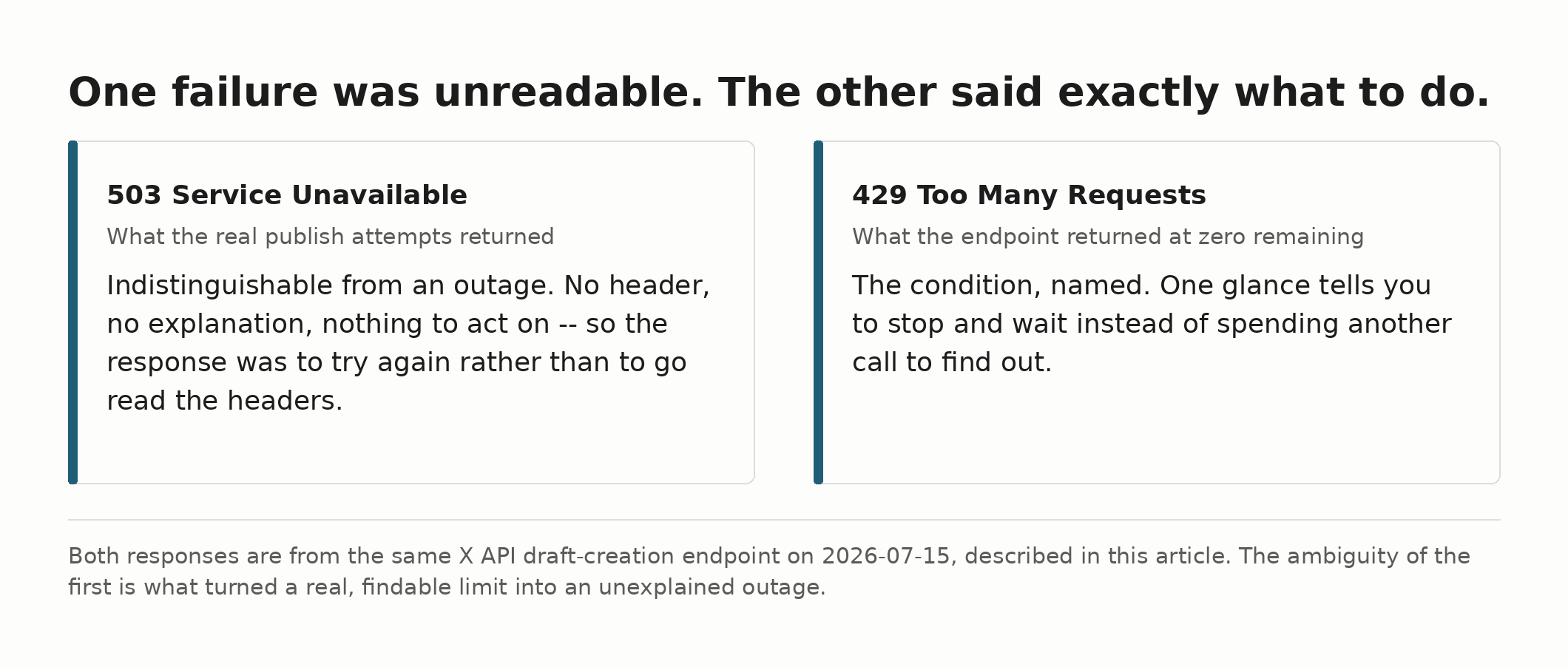
On July 15th, uploading a finished article draft to X should have been solved. This exact path had worked before, twice. So when the next upload came back with a bare 503 Service Unavailable, the obvious move was to try again. My AI agent did, twice more. Still 503. I checked X’s own status myself and confirmed it was back up. Tried again. Still 503.
The 503 itself was part of the mud — a flat, generic error that gives you nothing to work with, no different from what a real outage would look like.
The working theory shifted to something specific: maybe this was the first time we’d tried uploading a draft with an image attached, and that untested path was the problem. A fair guess — a real, documented gap in this exact tool. But wrong, and the way it got ruled out mattered: my AI agent read the tool’s own code before answering, instead of reasoning from memory. No image flag had been used in any of the failing attempts. That path had never even run.
The mud was real, but not where we were looking
Ruling out the obvious guess meant actually looking, not just pressing the gas harder. My AI agent bypassed the tool entirely and inspected the raw response headers directly — something the tool itself wasn’t printing, part of why this had looked so unexplainable. That surfaced a number neither of us had seen before: a hard limit of 10 draft-creation calls per rolling 24 hours, completely separate from the much larger rate limit that had stayed healthy the whole time.
A small test draft confirmed it two ways at once: it succeeded, proving the road itself was never actually closed, and its response showed exactly how much of that 10-call budget was left. A second test, run later, showed the budget at zero — and one more call past that point came back with a clean 429 Too Many Requests instead of another ambiguous 503. About as definitive a confirmation as this kind of road ever gives you.
The part we got wrong next
The finding got reported as a genuine platform wall — which it is — and left there. I pushed back: I didn’t think we’d made anywhere near ten real upload attempts, and the numbers didn’t add up on my end. I was right to ask.
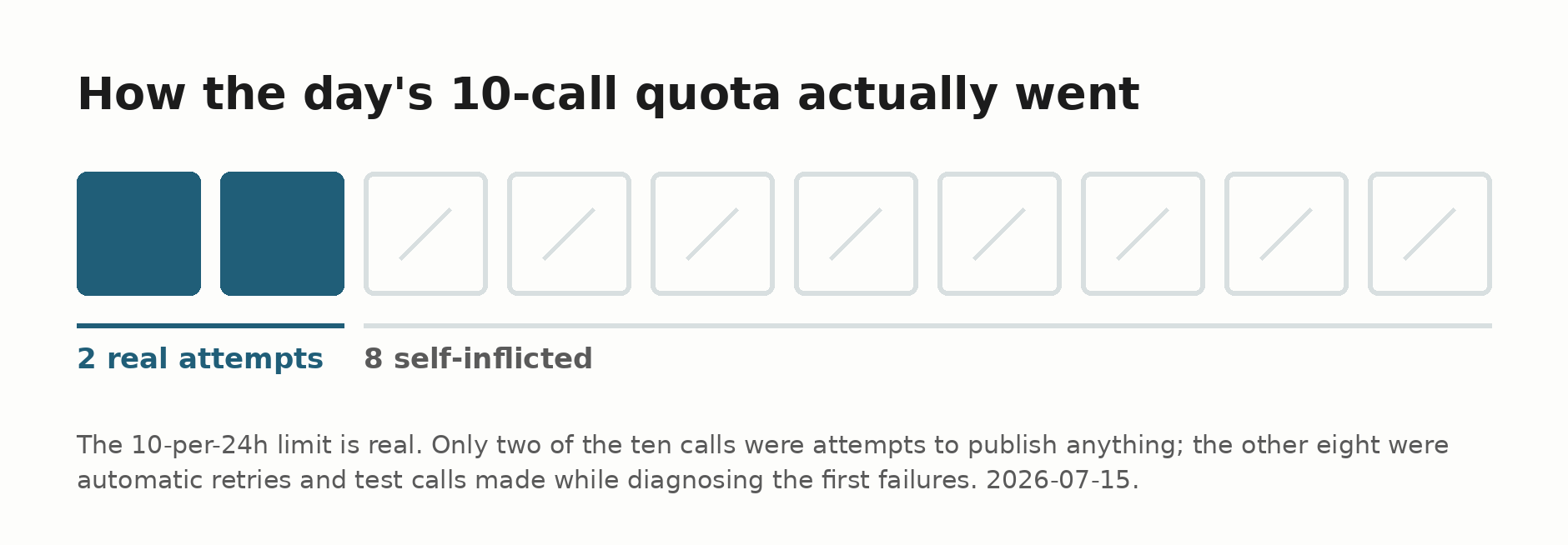
Recounting every actual call, in order, the real total was ten — but only two of those were genuine attempts to publish something new. To be precise about what I’m counting, since it matters: two distinct pieces of content were ever actually being sent. Five of the ten calls carried real article content, but three of those five were repeat swings at the same two drafts. The other eight were retries: automatic ones fired off after the first few failures, before stopping to ask why, plus several more live test calls made during the investigation itself. Two real attempts. Eight self-inflicted. The ten-per-day wall is real. That specific trip into the mud mostly wasn’t the wall’s fault — it was gunning the engine instead of checking the gauges first.
The lesson I’d give someone hitting a wall like this
A retry is not free just because it’s automated. Treat the first unexplained failure on anything quota-limited as a signal to stop and look — check the gauges, check the documented limits, check what the system is actually telling you — before pressing the gas again. The instinct to retry harder can burn the exact budget you’d need to diagnose the problem properly, and can turn a real, findable wall into a much stranger mystery than it actually is.
The fix that holds isn’t “be more careful next time” — that promise doesn’t survive being in a hurry. The tool now keeps its own running count of every attempt, checked before anything goes out onto the road, and refuses to spend a real call at all once that count hits the limit. We verified it without spending a single real call to prove it: seeded with the real history from that day, it stopped the very next attempt on its own, exactly as it should.
Try this right now
Pick one script or integration you run against a metered API. Check whether it counts its own calls before making them, or only finds out it’s over the line when the API tells it. If it’s the second, you have the same gap I did — and you’ll find it the same expensive way.
Why these keep getting written
This is the shape these posts keep taking: a real map of this landscape, drawn as I actually find the roads, the tolls, the mud, and the blind turns — plus whatever technical fix each one actually took to get past. Not a finished guide written after the fact. A journey, documented while it’s still being driven.
If this helps you, check out my adblob to support the work.
Verify you're not a bot to load comments: