If a Fork Is Unavoidable, Automate the Diff
July 2026
The rule: when the same content genuinely has to live in two places, the comparison between them is a script you run — not a careful reading you perform.
Why
Sometimes a fork can’t be prevented. A platform has no update path, an editor only exists on one side, a collaborator works somewhere you don’t. Fine. But the moment two copies exist, someone has to answer “what’s different, and which version is right?” — and that job is far more error-prone by hand than it looks.
Reading two long documents side by side is a task humans are specifically bad at. Attention decays, the eye skips what it expects to see, and the differences that matter most are often the smallest ones on the page.
What it cost us
On 2026-07-31 we reconciled a published article against its own published copy on another platform, sentence by sentence, by hand. The pass genuinely worked. It caught three real problems the second copy would otherwise have pushed back onto the first: a retracted income figure, a date we’d already independently proven wrong, and a growth claim with no evidence behind it.
And that same hand-comparison put a false statement into our own records. It reported that the published copy still contained an internal contradiction about income. A fresh, scripted pull of the live text later the same day found no such text anywhere in its 14,975 characters. The comparison had almost certainly been run against an uploaded draft rather than the published article — a mistake a script doesn’t make by accident, because the artifact it fetches is written down in the script instead of chosen in the moment.
That’s a narrower claim than “a script can’t get this wrong,” and the narrower one is the true one. A script points wherever you told it to point, and pointing it at a staging URL, a cached copy, or the wrong ID is entirely possible. What automation removes is the drift — the version where you meant the live article, had the draft open, and never noticed the difference.
So the scorecard for one manual reconciliation pass is: three real errors caught, one new false claim created. That’s a good result for hand work, and it still argues for the script.
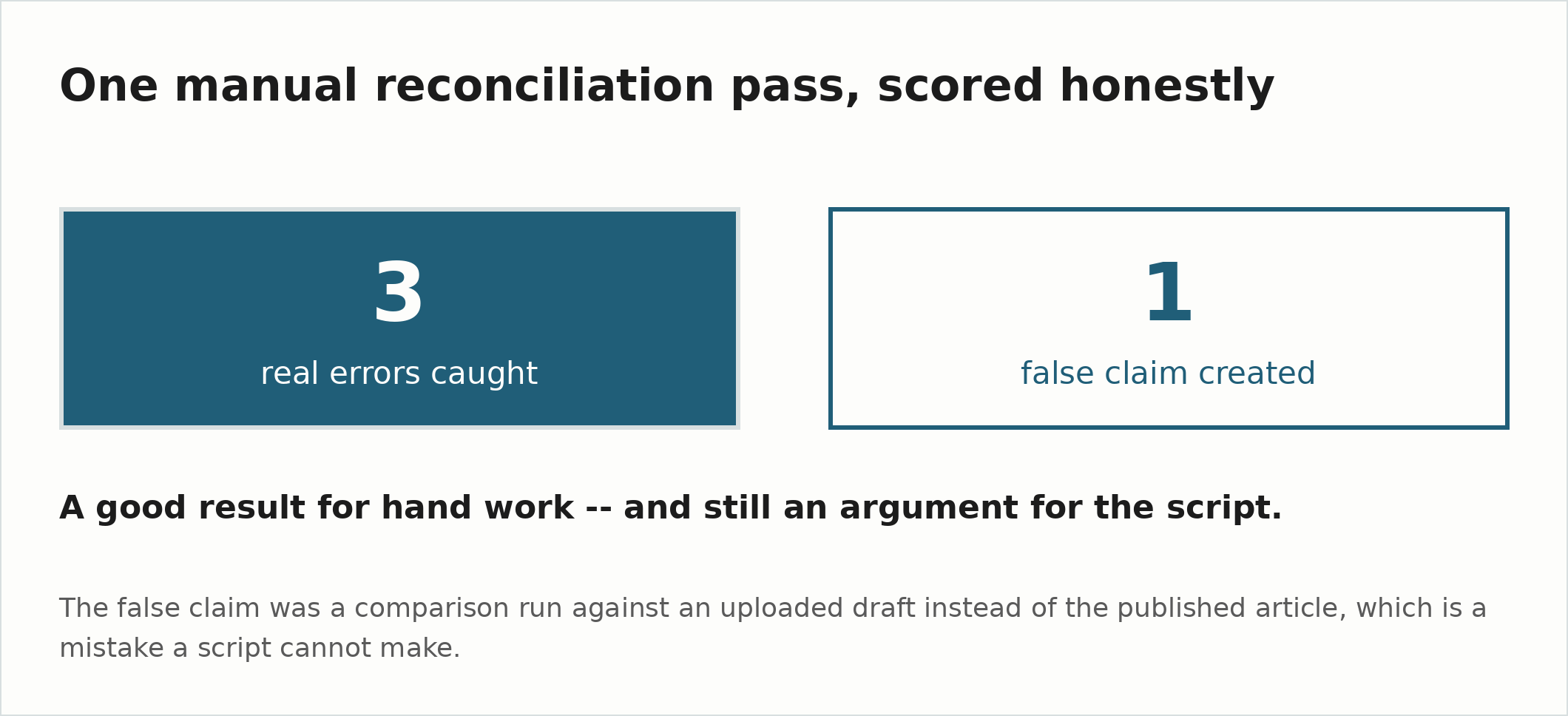
Both numbers came from the same careful pass, by the same person, on the same afternoon.
How to apply it
- Fetch both copies programmatically and diff them. If a platform lets you read published content back, that’s the feature that makes this possible — check for it early.
- Diff the published artifact on both sides. Comparing against a draft is the specific mistake above, and it’s an easy one because the draft is usually the copy that’s conveniently to hand.
- Let the script find the differences; keep the judgment for yourself. Deciding which version is right is real work that shouldn’t be automated. Finding the differences is mechanical and shouldn’t be manual.
- Write it before you’re tired. Reconciliation happens at the end of a long session, which is precisely when careful reading is least reliable.
The general form
Give the machine the part that’s mechanical and exhausting, and keep the part that needs judgment. A comparison you remember to do carefully is a good intention; a comparison you run is a mechanism.
Try this now
Find the last two-copy comparison you did by reading. Write the three-line version of it — fetch A, fetch B, diff — and save it next to the thing it compares. It doesn’t have to be good. It has to exist before the next tired evening when you’d otherwise read carefully instead.
This entry came out of The Bottleneck Is Also the Inspector. Better still is not forking at all — see Finish the Text Before It Forks.
If this helps you, check out my adblob to support the work.